
Interviewing and ultimately choosing an HOA management company can be a tedious and headache-inducing process, particularly when several providers appear to offer services that look pretty similar. Their proposals may promise responsive communication, reliable financial oversight, and experienced community managers, but those descriptions don’t always tell the board what working with each company will actually look like upon execution.
And what’s more, the decision goes beyond day-to-day administration. A management company’s performance can influence maintenance costs, homeowner happiness, financial reporting, and how efficiently the board operates.
Kuester Management Group provides HOA management services in Myrtle Beach SC, Charlotte NC, Huntersville NC, Wilmington NC, and Fort Mill SC. Keep on reading to access an HOA management company checklist that enables your HOA board members to have a consistent way to compare providers, ask meaningful questions, and identify potential problems prior to signing an agreement.
Begin by Identifying What Your HOA Actually Needs
Before you start calling potential vendors and requesting proposals, the HOA board members should meet and agree on which responsibilities they want a management company to handle.
A smaller community that doesn’t have lots of amenities may only require help with financial administration and occasional maintenance tasks. A larger association with a clubhouse, pool, playgrounds, private roads, and multiple vendors may require more extensive support.
Consider the size, budget, amenities, current challenges, and homeowner expectations in your community. This will help you decide if you require large-scale, full-service management or basic assistance with some responsibilities around the neighborhood.
Having these priorities established beforehand makes it easier to compare proposals and prevents the board from paying for services it may not need.
HOA Checklist: 10 Things to Evaluate
Use the following criteria when reviewing proposals and interviewing prospective management companies.
1. Experience and Reputation in the Industry
Experience matters, of course, but the number of years a company has been in business doesn’t tell the whole story. Find out whether it manages communities that are like yours in size, property type, amenities, and operational complexity.
Ask about its client retention, local experience, and familiarity with the challenges your homeowners association faces. A company that understands your type of community should be able to explain how it has handled comparable situations.
2. Licensing, Certifications, and Insurance
Be sure that the management company you’re considering meets all state licensing requirements and has the right types of insurance policies, including appropriate coverage.
Professional credentials and industry certifications show a commitment to ongoing education and proven management practices.
Requirements differ by state, so HOA board members should check which qualifications apply instead of assuming all management companies follow the same rules.
3. Financial Management and Reporting
Financial oversight is one of the most important services an HOA management company can provide.
Ask how the company handles annual budgets, assessment collection, expense tracking, accounts payable, reserve study reporting, and financial statements.
Find out how frequently the board receives financial records and whether members can easily access financial information. Clear, timely reporting allows board members to understand the association’s financial position without repeatedly requesting basic information.

4. Property Maintenance and Vendor Management
A management company should have a set process for coordinating repairs, scheduling inspections, getting contractor proposals, and checking completed work.
Ask how property maintenance requests are tracked, how vendor performance reviews are handled, and who verifies that services meet contract requirements.
Emergency procedures deserve particular attention. The board should understand what happens when a major problem occurs outside regular business hours and who has authority to authorize necessary work.
5. Communication and Homeowner Support
Issues with communication can quickly stand in the way of an otherwise productive management relationship.
Find out how homeowners submit questions, report concerns, and receive updates. Ask about expected response times, escalation procedures, and how the company communicates with the board.
Pay attention to the experience during the interview process as well. If obtaining straightforward answers is already difficult, imagine how future communication will be handled.
6. Technology and Online Homeowner Tools
Technology, such as management software, should make HOA administration easier for board members and residents.
Ask whether the company provides online assessment payments, homeowner portals, document access, maintenance request tracking, and digital financial reports.
Request a demonstration whenever possible. An impressive list of technology features means little if the tools are difficult to navigate or don’t provide the information and data your community needs.
7. Knowledge of HOA Laws and Regulations
A property management company should know the laws and requirements that affect the communities it serves, including state regulations, governing documents, recordkeeping, and administrative procedures.
Ask how the company keeps up with regulatory changes and community governance, as well as when it suggests involving association counsel to review legal documents.
Management guidance is helpful, but it is not the same as legal advice.
8. Management Fees and Contract Transparency
Compare the complete cost of each proposal, not just the monthly management fee.
Find out which services are included and which generate additional charges. These may involve board meeting attendance, special projects, document preparation, inspections, administrative services, or other work outside the standard agreement.
Check how long the contract lasts and if it renews automatically. Also, ask about annual fee increases, termination terms, and any costs for ending the relationship.
A lower monthly fee might sound nice to the HOA’s checkbook, but have little value if essential services cost extra.
9. Staffing and Dedicated Community Support
Inquire as to who will serve as your community manager and what experience that person brings to the role.
The board should also understand the community manager’s workload, availability, responsibilities, and backup support during vacations or unexpected absences.
A company may have an excellent reputation, but the association’s day-to-day experience will depend heavily on the people assigned to its account.
10. Client References and Transition Support
Request references from communities comparable to yours and follow through by contacting them.
Ask about communication, financial accuracy, maintenance coordination, responsiveness, and whether the property management company has delivered on its commitments.
Also discuss onboarding. A well-organized management company should have a process for collecting association records, reviewing vendor contracts, establishing financial procedures, and addressing outstanding issues when taking over an account.
Questions to Ask an HOA Management Company
Use these questions during interviews to obtain specific information rather than general assurances:
- How many communities do you currently manage, and how many are similar to ours?
- What services are included in your standard fee?
- Which services are assigned additional charges?
- Who will be our community manager, and what is their workload?
- How often will the board receive financial reports?
- How are maintenance tasks and emergency situations handled?
- What homeowner tools are available?
- How do you handle contractor performance reviews?
- Can you provide references from current HOA clients?
- What does your onboarding process involve?
Request written clarification when answers are incomplete or differ from the proposal. This information may become important when reviewing the final agreement.
How to Compare HOA Management Companies
After reviewing proposals, use this HOA checklist to evaluate each provider in the same way.
Rate each category from 1 to 5, where 1 means poor alignment with your needs and 5 means an excellent fit.
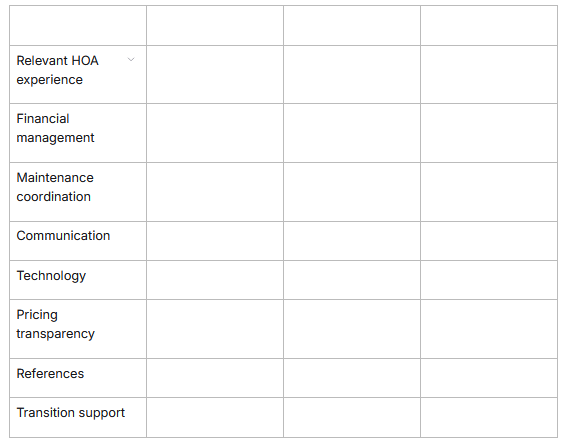
HOA board members may decide that certain categories are more important than others. For example, if your association has financial reporting issues, you might focus on accounting. If your community’s infrastructure is past its prime, you may prioritize maintenance coordination.
Write down the reasons for each score. The goal is to find the company that best meets your community’s needs, not just the one with the highest score.
Red Flags to Watch Out For
Some warning signs can show up long before you sign a management agreement.
Be careful if a company gives vague pricing, avoids talking about extra fees, cannot explain its financial reporting, or isn’t able to discuss how it handles maintenance emergencies.
Other concerns are if the company will not provide references, has unclear termination terms, little experience with similar communities, or no clear onboarding process.
One unanswered question does not always mean a company is not right, but if it is hard to get clear information again and again, you should look into it further.
What Happens After Selecting a Management Company?

Once HOA board members identify their preferred management company, review the management agreement carefully before signing.
Confirm that the contract accurately describes the services promised, reporting expectations, fees, responsibilities, and termination provisions. For significant concerns or unfamiliar contract language, consider having association counsel review the agreement.
If the HOA is switching providers, establish a transition checklist and schedule that addresses the transfer of financial records, bank account information, governing documents, homeowner records, vendor contracts, outstanding work orders, and other essential information.
The outgoing and incoming property management companies may need to coordinate, but the board should remain involved to ensure important records and responsibilities aren’t overlooked.
Final HOA Management Company Checklist Before Signing
Before approving the agreement, confirm that your HOA board can check off the following:
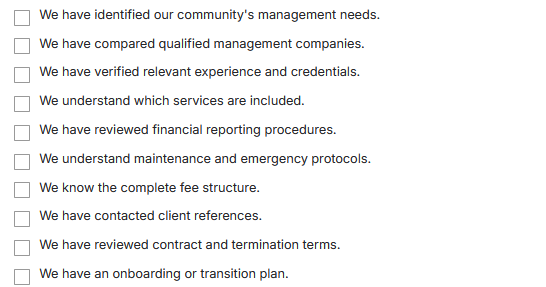
If several items remain unresolved, address them before committing to a management relationship.
Find the Right Management Partner for Your Community
An HOA management company should make board responsibilities easier for community leaders while providing the services that residents expect.
Using a consistent evaluation checklist helps boards look beyond polished presentations and compare what each company will actually deliver.
Kuester works with homeowners associations seeking experienced management support across both North Carolina and South Carolina. If your board is evaluating management companies or considering a change, contact Kuester to discuss your community’s needs and learn more about the services available.
FAQs
What should be included in an HOA management company checklist?
Evaluate things like experience, qualifications, financial stability, maintenance coordination, communication, technology, pricing, staffing, references, and contract terms.
How do you choose the right HOA management company?
Identify your community’s needs, compare qualified providers, conduct interviews, check references, and review proposals and contracts before deciding.
What questions should an HOA board ask a management company?
Ask about services, fees, financial reporting, assigned staff, communication procedures, maintenance coordination, emergency response, and onboarding.
How much does an HOA management company typically charge?
Fees vary based on community size, location, amenities, service requirements, and management responsibilities. Companies may charge a monthly fee with additional costs for certain services, so review the complete pricing structure.
What services should an HOA management company provide?
Depending on the agreement, services may include financial administration, budgeting assistance, assessment collection, maintenance coordination, vendor oversight, recordkeeping, and homeowner tools.
What are the red flags of a bad HOA management company?
Poor responsiveness, unclear fees, inconsistent financial reporting, inadequate maintenance procedures, limited qualifications, and vague contract provisions can indicate potential problems.
Can an HOA switch management companies?
Yes, subject to its governing documents, existing contract obligations, and applicable requirements. The transition should include transferring financial records, association documents, vendor information, and outstanding maintenance matters.
Should an HOA hire a management company or self-manage?
The decision depends on community size, operational complexity, available volunteers, and budget. Self-management may work for some associations, while others benefit from professional support with finances, maintenance, and administration.