

Ask five HOA board members what they think of a vendor, and you may get five very different answers. One person likes the landscaper because the property looks good. Another is frustrated because emails go unanswered. Someone else thinks the price is too high, while a fourth board member remembers that the previous company was cheaper but generated twice as many homeowner complaints.
None of those observations is necessarily wrong. The problem is that they are difficult to use as the basis for a fair vendor decision.
An HOA vendor scorecard gives boards a more consistent way to evaluate contractors. Rather than relying on impressions, price alone, or whoever speaks most forcefully at the board meeting, the association identifies what matters, establishes a rating system, and evaluates vendors against those expectations.
The same approach can be useful long after a contract is signed.
Kuester Management Group is a premier provider of HOA management company in Charlotte NC, Myrtle Beach SC, Huntersville NC, Wilmington NC, and Fort Mill SC. In this blog, we will provide actionable tips you can use when engaging in vendor evaluations.
What’s an HOA Vendor Scorecard?
An HOA vendor scorecard is a tool that helps boards rate contractors using set criteria. Boards can use it when choosing a new vendor, checking on an active contract, doing regular reviews, or deciding if a service should be renewed or put out for bid again.
Consistency is what matters most.
Rather than just saying, “The pool company seems to be doing okay,” the board can check performance indicators, including if scheduled services were completed, problems were fixed on time, invoices matched the contract, homeowner complaints were handled, and communication met expectations.
This gives the board something more useful than just a general impression. It creates a clear record.
Comparison Matrix vs. Vendor Scorecard: What’s the Difference?
The terms are sometimes used interchangeably, but they serve slightly different purposes.
A vendor comparison matrix organizes information from competing proposals side by side. It might show each contractor’s price, warranty, insurance coverage, timeline, references, and proposed scope.
A vendor scorecard goes one step further by assigning ratings to those criteria. The HOA may also give more weight to certain factors based on the needs of the project.
Once a vendor is hired, a performance scorecard shifts the focus again. Now the question is no longer what the contractor promised. It’s if the contractor is actually fulfilling their contract terms.
Start With the Purpose of the Vendor Scorecard
There is no reason for every HOA vendor scorecard to look exactly alike. A board comparing roofing contractors needs different information than one evaluating an existing cleaning company.
Before choosing criteria, decide what performance metrics the scorecard must accomplish.
You may be trying to:
- Compare several landscaping proposals.
- Select a contractor for a capital project.
- Evaluate an existing pool or maintenance company.
- Track performance during a major project.
- Determine whether a contract should be renewed.
- Document recurring service problems.
Once the purpose is clear, choosing meaningful metrics becomes much easier.
Set the Non-Negotiables First
Some vendor requirements shouldn’t just earn points. They should be pass-or-fail.
Think about it like this: Depending on what work is being done as well as what is required in the contract scope, a contractor may need appropriate licensing, general liability insurance, workers’ compensation coverage, permits, bonding, or specific certifications.
A contractor shouldn’t be able to make up for missing an essential requirement just by having a good price or great communication.
Check these basics first before you spend time debating whether “ABC Company” deserves a four or a five on their vendor performance.
Keep the Scoring System Simple

A five-point scale works well because it gives enough detail without making vendor evaluation too complicated.
A board might define the ratings like this:
- 1 – Poor: Significantly below expectations
- 2 – Needs Improvement: Frequently misses expectations
- 3 – Meets Expectations: Acceptable performance
- 4 – Very Good: Consistently exceeds basic expectations
- 5 – Excellent: Outstanding performance
Make sure you define what each number means. If you don’t have clear descriptions, one board member’s “3” might mean satisfactory, while another’s means the contractor is barely scraping by.
For major vendor selections, board members can also fill out their evaluations on their own before discussing the results. This helps reveal differences in how people understood the proposals, instead of letting the first opinion in the room shape the whole conversation.
Not Everything Should Count the Same
It’s true that price matters, but does it need to count as much as technical expertise when replacing a roof? Probably not. For a simple recurring service, price, reliability, and responsiveness might matter more.
That’s where weighted scoring helps.
A sample HOA vendor scorecard might look like this:
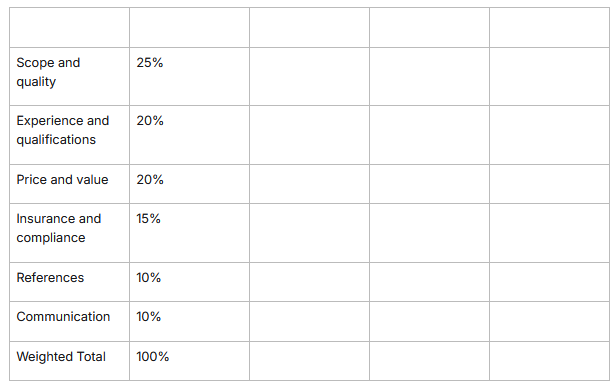
These percentages are just a starting point. The board should adjust them based on the cost, complexity, and risk of the contract scope.
What Should an HOA Score Before Hiring a Vendor?
A good scorecard makes the board look beyond just the number at the bottom of the proposal.
Scope and Proposal Quality
Does the proposal cover everything the HOA asked for? Check the materials, exclusions, responsibilities, deliverables, timing, and any assumptions the contractor made.
A vague proposal with a good price can end up costing more once work starts and people realize they had different ideas about what was included.
Price and Overall Value
Price should be considered in context. Look at the total cost, included services, allowances, extra fees, change order rates, exclusions, and likely long-term costs.
The cheapest proposal isn’t always the best value, and the most expensive one isn’t always the best quality.
Experience and Qualifications
Look for experience with similar projects and communities, technical skills, enough staff, certifications, and special equipment if needed.
Experience with HOAs is especially helpful because these projects often involve resident communication, shared spaces, access limits, and scheduling issues that don’t come up as much in other jobs.
References
Just collecting names isn’t the same as actually checking references.
Ask past clients about service quality, reliability, communication, budget, purchase orders, warranty response, and how the contractor handled problems. One of the best questions is simple: Would you hire this company again?
Communication and Contract Terms
Notice how responsive vendors are during the bidding process. Since vendors usually try to make a good impression before getting the job, repeated communication problems at this stage are a red flag.
The board should also look at contract length, contract renewal terms, termination rights, future price increases, payment terms, warranties, and purchase order procedures before giving a final score.
Create a Different Vendor Scorecard Once Work Begins
The criteria used to hire a contractor should evolve once that contractor is working for the community.
An HOA vendor performance scorecard could be much simpler:
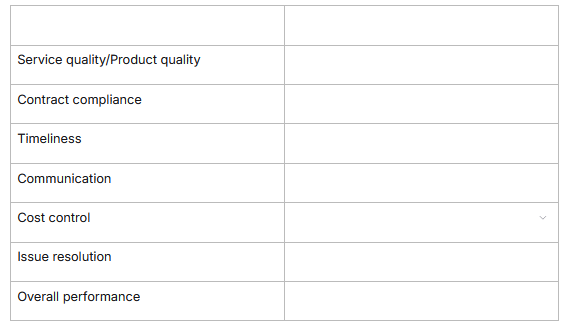
The objective is focused on performance management; actual results against what the vendor agreed to provide.
If landscaping was supposed to happen each week, did that happen? If the contract identifies targeted response times, did they deliver? If the project has milestones, did the contractor accomplish them according to schedule? If invoices need to align with an agreed pricing structure, do they?
A scorecard should not penalize a vendor for expectations that never appeared in the contract.
Back Up Scores With Evidence

“This vendor is awful” is not very useful documentation.
“Three scheduled services were missed during the quarter, and two required follow-up requests before they were completed” is.
Useful evidence includes inspection reports, photos, work orders, invoices, completion dates, maintenance logs, documented homeowner complaints, emails, and specific contract requirements.
Homeowner feedback can be part of the evaluation, especially for visible services like landscaping, cleaning, or pool maintenance. But complaints should be reviewed with other evidence, not just used to lower a vendor’s score every time someone is unhappy.
This keeps the scorecard focused on performance, not popularity.
Review Performance Enough to Matter
Not every vendor needs to be issued a monthly report card.
A major capital project may need frequent evaluations, while a stable long-term contractor might be reviewed quarterly, semiannually, or before annual renewal.
Consider the contract’s:
- Value
- Risk
- Service frequency
- Complexity
- Previous performance problems
- Renewal date
More importantly, pay attention to trends. One bad review could just be a rough month. But if scores drop from 4.5 to 3.8 to 2.9, that points to a bigger problem.
This pattern gives the board a chance to step in before a small problem turns into a reason to end the relationship.
Share Expectations With the Vendor
The scorecard and performance data works better when it isn’t a secret.
Ultimately, whenever this is possible, vendors should know what the association expects, which supplier performance measures matter, how often their work will be reviewed, and how concerns will be shared.
If vendor performance slips, document the issue and connect it to the contract. Note what happened, when it occurred, which requirement was affected, what corrective action was requested, and if the problem was resolved.
The goal should be improvement whenever possible. A strong vendor relationship benefits the community, and clear feedback gives a good contractor a chance to fix problems before the HOA board looks elsewhere.
Know When a Score Isn’t the Whole Story
A numerical system is helpful, but it should never replace good judgment.
A vendor could have great performance data overall but still develop serious problems like lapsed insurance, an inactive license, unauthorized charges, safety violations, unapproved subcontractors, or repeated contract violations.
These issues may require action no matter what the average score is.
Similarly, the contractor with the highest score does not automatically have to get the contract. The scorecard gives the board helpful information for making a decision, but it does not make the decision for them.
Use Vendor Scores at Contract Renewal Time
Contract renewal should not begin with, “Has anyone had any problems with this guy?”
Review the supplier’s record.
Look at overall scores, performance trends, documented complaints, corrective actions, contract compliance, proposed pricing changes, and current market alternatives. From there, the HOA board can determine whether it makes sense to renew, renegotiate, request specific improvements, rebid the service, or consider another provider.
Keep completed scorecards with the association’s vendor records along with proposals, inspection reports, correspondence, corrective action plans, contract amendments, and renewal decisions.
That history becomes especially valuable as board membership changes. A new HOA board should not have to reconstruct three years of vendor performance from old emails and institutional memory.
How Professional HOA Management Helps with Vendor Management
Creating the scorecard is the easy part. Someone still has to be in charge of vendor management and gather the information behind the scores, inspect work, track service problems, communicate with contractors, maintain documentation, and bring useful information back to the board.
Kuester provides HOA management services in both North Carolina and South Carolina that can help HOA boards bring more structure to both vendor selection and ongoing oversight.
Professional management can assist with gathering comparable bids, verifying qualifications and insurance, coordinating references, conducting property inspections, documenting service issues, communicating corrective actions, and preparing vendor performance information for board review. This allows the HOA board to make contract decisions using a consistent record rather than starting from scratch every time a renewal approaches.
Take the Guesswork Out of Vendor Decisions
HOA boards don’t need some overly complicated procurement system to make better vendor decisions. What they need, rather, is clear expectations, meaningful criteria, consistent evaluation, and documentation they can actually use.
An HOA vendor scorecard brings all of this together and cuts out the confusion. It can help a board choose between contractors, spot performance problems early, have better conversations with vendors, and make renewal decisions based on more than just memory.
If your community needs help choosing contractors, monitoring vendor performance, coordinating projects, or managing service level agreements, Kuester can help. Our team supports HOA boards throughout the Carolinas with vendor management, financial oversight, maintenance coordination, board guidance, and the daily work needed to keep communities running smoothly.
Reach out to our team today to schedule a 1:1 consultation.
FAQs
What is an HOA vendor scorecard
An HOA vendor scorecard is a structured evaluation tool used to compare prospective contractors or measure the performance of existing vendors using predetermined criteria and ratings.
What should be included in an HOA vendor scorecard?
Common criteria include price and value, quality, experience, qualifications, insurance, licensing, references, communication, contract terms, timeliness, and compliance. The exact categories should reflect the service or project being evaluated.
What is the difference between a vendor scorecard and a comparison matrix?
A comparison matrix organizes information from multiple proposals side by side. A scorecard assigns numerical ratings to selected criteria and may weight certain factors according to their importance.
How should an HOA score vendors?
A simple 1-to-5 system works well when each number has a clearly defined meaning. Boards should establish the criteria and rating definitions before evaluating vendors so everyone uses the scale consistently.
Should an HOA vendor scorecard use weighted criteria?
It can. Weighted scoring is useful when certain factors deserve more influence than others. The weights should reflect the project’s complexity, cost, and risk rather than using identical percentages for every vendor decision.
How much weight should price receive?
There is no universal percentage. Price should be considered alongside scope, quality, experience, qualifications, risk, and long-term value.
Should the HOA automatically hire the vendor with the highest score?
No. A scorecard should inform the board’s judgment rather than replace it. Serious compliance concerns, unclear proposal terms, or other issues may require additional consideration regardless of the numerical result.
How often should HOA vendors be evaluated?
It depends on the contract. High-value projects, frequently performed services, or vendors with performance problems may require more frequent evaluation, while stable contracts may be reviewed less often or before renewal.
Who should complete the vendor scorecard?
Input may come from community managers, board or committee members, project professionals, maintenance personnel, or others with direct knowledge of the work. The people closest to a particular aspect of the service may be best positioned to evaluate it.
Should vendors see their scorecards?
Sharing relevant expectations and performance feedback can be productive. It gives vendors a clear understanding of how their work is being evaluated and an opportunity to correct problems.
What happens when an HOA vendor receives a poor score?
The board or management team should identify the underlying problems, compare them with contract requirements, document the issues, communicate with the vendor, and establish corrective actions when appropriate. Continued poor performance may eventually support renegotiating, rebidding, or terminating the contract.
Can homeowner complaints be included in a vendor scorecard?
Yes, but complaints should be documented and considered alongside objective evidence. A complaint may identify a legitimate service problem, but it should not automatically determine the vendor’s rating.
How can a vendor scorecard help with contract renewals?
Historical scores provide a record of quality, reliability, communication, compliance, and recurring problems. That information gives the board a stronger basis for deciding whether to renew, renegotiate, rebid, or replace a vendor.
How can an HOA management company help with vendor scorecards?
An HOA management company can help establish evaluation criteria, gather performance information, conduct inspections, document issues, coordinate vendor communication, prepare information for board review, and use performance history during renewal or rebidding decisions.