

Being elected or appointed to your community association board is both an honor and a significant responsibility. Whether you volunteered to make a difference in your neighborhood or were encouraged by your neighbors to serve, stepping into the role can feel overwhelming. Suddenly, you are reviewing financial reports, learning unfamiliar governing documents, studying rules and regulations, responding to homeowner concerns, and helping make decisions that affect the entire community.
The good news is that you do not have to master everything in your first month. In fact, your first 30 days should be focused on learning rather than leading major initiatives. The most successful new board members take time to understand how the association operates, build relationships with fellow board members and management, and develop a solid understanding of the community before proposing significant changes.
This guide provides a practical week-by-week roadmap to help you get started. By the end of your first month, you should have a clear understanding of your responsibilities, your community’s priorities, and how to contribute confidently to board discussions and decisions.
At Kuester Management Group, a leading provider of HOA Management in Myrtle Beach SC, Charlotte NC, Huntersville NC, Wilmington NC, and Fort Mill SC, we regularly partner with HOA board members just like you to get acclimated and thereby enable your success.
Your First 30 Days at a Glance
| Timeframe | Primary Focus | Key Actions | Desired Outcome |
|---|---|---|---|
| Week 1 | Learn the fundamentals | Review governing documents, recent meeting minutes, and board procedures | Understand your role and how the association operates |
| Week 2 | Understand the finances | Review budgets, financial reports, reserves, insurance, and contracts | Gain a clear picture of the HOA’s financial health |
| Week 3 | Learn how the community functions | Meet key people, review current projects, and understand operations | Build relationships and understand ongoing priorities |
| Week 4 | Begin contributing | Prepare for meetings, identify priorities, and establish a communication routine | Participate confidently while continuing to learn |
Three Priorities for Your First Month
It is natural to want to make an immediate impact, especially if you were elected because homeowners wanted change. However, your first month is not the time to rewrite rules and regulations, or launch major initiatives.
Instead, focus on three priorities that will set you up for long-term success:
- Learn before trying to lead major changes.
- Understand how the community association currently operates.
- Work collaboratively with other HOA board members.
Every community has a history. Decisions that may seem confusing at first often have context that is not immediately obvious. Taking the time to understand that context will help you make better decisions and earn the trust of your fellow board members.
Week 1: Understand Your Role and Learn the Basics
Your first week should be dedicated to orientation. Before you can make informed decisions, you need to understand how your association is governed and how the board functions as a whole.
One of the biggest misconceptions among first-time board members is believing they immediately have the authority to act on behalf of the association. In reality, individual board members generally do not have independent decision-making authority. The board acts collectively through properly noticed meetings, discussions, and votes.
Understanding this distinction early helps prevent misunderstandings with homeowners and fellow directors.
Start With the Governing Documents
The governing documents are the foundation of every HOA decision. While they may seem intimidating at first, becoming familiar with these documents should be your highest priority.
Take time to review:
- The Declaration or CC&Rs (Covenants, Conditions, and Restrictions)
- The association’s bylaws
- Rules and regulations
- Board policies and resolutions
- Architectural guidelines, if applicable
You do not need to memorize every provision during your first week. Instead, focus on understanding how the documents are organized and where to find answers when questions arise.
Read Recent Board Meeting Minutes
Meeting minutes provide valuable context that you cannot get from governing documents alone. They show what issues the board has been discussing, which projects are underway, and what challenges the community is currently facing.
As you review recent minutes, pay attention to:
- Ongoing maintenance projects
- Financial decisions
- Vendor approvals
- Homeowner concerns
- Upcoming community initiatives
- Recurring issues discussed by the board
Reading several months of minutes often reveals patterns that help explain current priorities.
Learn How the Board Is Structured
Every board member has the same fiduciary duty to act in the best interests of the association, but individual officers have different responsibilities.
During your first week, learn:
- The responsibilities of the president, vice president, secretary, and treasurer
- How committees support the board
- Which responsibilities belong to the board versus the community manager
- How meetings are scheduled and conducted
- Voting procedures and quorum requirements
Understanding who is responsible for what will make it much easier to participate effectively.
Documents to Request During Your First Week
One of the quickest ways to become productive is to make sure you have access to the same information as the rest of the board.
Request copies of:
- Governing documents
- Current board roster
- Recent meeting minutes
- Annual calendar
- Current operating budget
- Most recent financial statements
- Reserve study or reserve funding plan
- Insurance summaries
- Vendor contracts
- Board policies
- Community directory (if appropriate)
- Access to board email accounts, portals, calendars, and document storage systems
Having these materials readily available will make learning much easier over the coming weeks.
Resist the Urge to Fix Everything
As you learn more about the community, you will almost certainly identify things you believe could be improved. That is perfectly normal.
However, before proposing changes, ask questions.
Why was a particular decision made? Has the board already explored other options? Are there legal, financial, or operational considerations that are not immediately obvious?
Listening first often leads to better long-term decisions than acting quickly.

Week 2: Develop a Clear Understanding of the HOA’s Financial Health
Even if you are not serving as treasurer, every board member shares responsibility for the association’s financial well-being. You do not need to become an accountant, but you should understand the basics of how the HOA manages its finances.
The second week is the ideal time to review the association’s financial position and become familiar with the reports you will see at future meetings.
Review the Operating Budget
The operating budget tells the financial story of your community. It outlines where assessment income comes from and how those funds are allocated throughout the year.
As you review the budget, consider:
- How assessments are being used
- Which categories represent the largest expenses in a fiscal year
- Whether spending appears consistent with community priorities
- Any areas where costs have increased significantly
Understanding the budget provides valuable context for nearly every decision the board makes.
Become Familiar With Financial Reports
Financial reports may seem overwhelming at first, but you do not need to understand every accounting detail immediately.
Start by reviewing:
- Balance sheet
- Income statement
- Budget versus actual report
- Cash balances
- Reserve fund balances
- Delinquency summaries
Rather than focusing on individual numbers, look for broader trends. Are expenses tracking close to budget? Are reserve contributions being made consistently in the fiscal year? Is assessment income keeping pace with expectations?
If something is unclear, remember to ask questions. Experienced board members, the treasurer, community manager, or accountant can help explain unfamiliar reports.
Review Reserve Funding and Upcoming Capital Projects
One of the board’s most important responsibilities is preparing for future repairs and replacements.
Reserve funds are money set aside for major community expenses such as roof replacements, road resurfacing, clubhouse renovations, or other large capital projects.
During your second week, review:
- The latest reserve study
- Current reserve balances
- Planned capital improvements
- Major repair schedules
- Long-term funding projections
Understanding these items helps you appreciate how today’s financial decisions affect the community years into the future.
Understand Current Financial Obligations
Beyond reviewing reports, take time to understand the association’s larger financial commitments.
This includes reviewing:
- Major vendor contracts
- Insurance coverage
- Upcoming contract renewals
- Pending insurance claims
- Existing special assessments, if any
- Significant ongoing projects
- Outstanding financial concerns
You should also ask whether there are any pending lawsuits, major repair projects, or financial issues that could affect future budgets.
Identifying these obligations early will help you participate more confidently in future board discussions.
Week 3: Build Relationships and Learn How the Community Operates
By your third week, you should have a solid understanding of the association’s governing documents and financial position. Now it is time to focus on something equally important: knowing how the community functions on a day-to-day basis.
Strong HOA boards are built on relationships. The better you understand the people involved in operating your community, the easier it will be to make informed decisions and work collaboratively with your fellow board members.
Meet the People Who Keep the Community Running
An HOA is supported by far more than the board itself. Behind every successful community is a network of professionals, volunteers, and committee members who help carry out the board’s decisions.
If possible, take time to introduce yourself to:
- Fellow HOA board members
- The community association manager
- Committee chairs
- Key vendors and contractors
- The association’s attorney or CPA, when appropriate
- The outgoing board member, if one is available
These conversations are not intended to solve problems. Instead, use them as opportunities to learn how each person contributes to the association and what challenges they currently see within the community.
Understand Current Projects and Priorities
Every HOA has projects already in progress when a new board member joins. Before proposing new initiatives, spend time understanding what the board is already working toward.
Ask questions such as:
- What maintenance projects are currently underway?
- Are any large capital improvements planned?
- Which vendor contracts are being reviewed?
- What homeowner concerns are receiving the most attention?
- Are there important deadlines approaching?
Pinpointing current priorities allows you to contribute more effectively without unintentionally disrupting existing plans.
Learn How the Community Communicates
Communication plays a major role in homeowner satisfaction. During your third week, learn how information flows between the board, management, and residents.
Review topics such as:
- Community newsletters
- Email updates
- Resident portals
- Social media policies
- Complaint procedures
- Emergency communications
Getting to know the association’s communication process helps ensure homeowners receive consistent information rather than conflicting messages from individual board members.
Observe Before Recommending Changes
As you become more familiar with community operations, you will likely identify processes you believe could be improved.
Resist the temptation to recommend changes immediately.
Instead, ask questions like:
- Why was this process established?
- Has the board tried a different approach before?
- What challenges led to the current procedure?
- Are there legal or contractual considerations involved?
Understanding the history behind a process often provides valuable perspective that is not immediately obvious.

Week 4: Begin Participating With Confidence
By the fourth week, you should feel much more comfortable participating in board discussions. While you will still be learning, you should also begin contributing thoughtfully to conversations and decisions.
The goal is not to have every answer. It is to ask informed questions, understand the issues before the board, and become a productive member of the leadership team.
Prepare for Your Next Board Meeting
One of the easiest ways to contribute effectively is to prepare before each meeting.
Before attending, review:
- The meeting agenda
- Supporting reports
- Financial statements
- Committee updates
- Vendor proposals
- Architectural applications
- Previous meeting minutes
If questions arise while reviewing the materials, consider asking them before the meeting whenever appropriate. This often leads to more productive discussions and allows management or other board members time to gather additional information.
Focus on One or Two Meaningful Priorities
New board members sometimes feel pressure to tackle every issue at once. In reality, the most successful leaders focus on making steady progress rather than dramatic change.
As you complete your first month, identify one or two areas where you believe you can make a meaningful contribution.
Examples might include:
- Improving homeowner communication
- Supporting committee initiatives
- Learning more about reserve planning
- Helping organize community events
- Reviewing maintenance planning processes
Choosing realistic priorities allows you to contribute without becoming overwhelmed.
Establish a Routine
Serving on an HOA board becomes much easier once you establish consistent habits.
Develop a routine that includes:
- Reviewing board materials before meetings
- Reading community communications regularly
- Staying informed about current projects
- Responding professionally to homeowner questions
- Tracking important deadlines and upcoming meetings
Small, consistent efforts are often far more effective than trying to address everything at once.
Continue Learning
Your first month is only the beginning of your HOA board service.
As your responsibilities grow, continue looking for opportunities to strengthen your understanding of:
- Community governance
- Financial management
- Reserve planning
- Risk management
- Vendor oversight
- Leadership and communication
The more knowledge you gain, the more confident you will become when making decisions on behalf of your community.
What Not to Do During Your First 30 Days
Your first month on the executive board is just as much about avoiding common mistakes as it is about learning new responsibilities.
Do your best to avoid the following:
- Do not attempt to rewrite rules immediately.
- Do not promise homeowners that you can solve individual issues on your own.
- Do not act independently on behalf of the board without authorization.
- Do not use your position to settle personal disputes.
- Do not discuss confidential matters outside authorized settings.
- Do not assume previous board decisions were poor without understanding the history behind them.
- Do not micromanage contractors or the community manager.
- Do not ignore financial reports simply because another board member oversees finances.
- Do not respond emotionally to homeowner complaints.
- Do not enforce rules inconsistently.
Approaching your new role with patience, professionalism, and curiosity will earn far more respect than trying to make immediate changes.
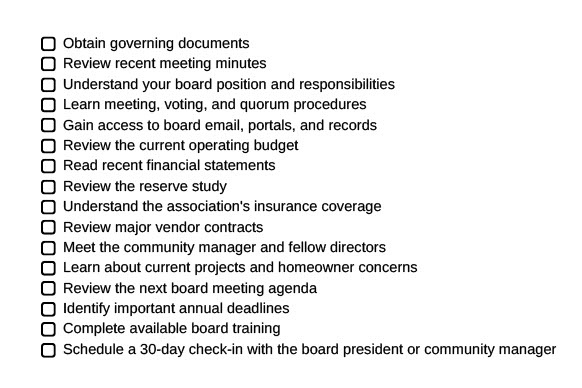
New HOA Board Member 30-Day Checklist
As you complete your first month, make sure you have accomplished the following:
How Professional HOA Management Supports New Board Members
Even the most dedicated volunteers benefit from having experienced professionals to help navigate the complexities of community governance.
A professional HOA management team serves as a resource for the board by providing organization, continuity, and administrative support. Rather than replacing the board’s authority, management professionals help carry out board-approved decisions while keeping day-to-day operations running smoothly.
Kuester Management Group partners with volunteer boards by helping them:
- Organize governing documents and association records
- Prepare for board and annual meetings
- Review budgets and financial reports
- Coordinate vendor contracts and maintenance projects
- Track recurring deadlines and compliance requirements
- Support homeowner communication
- Provide onboarding guidance and continuing board education
This partnership allows volunteer leaders to focus on governance and long-term planning while relying on experienced professionals for administrative and operational support.
Build a Strong Foundation for Board Service
Your first 30 days on an HOA board will shape how confidently you serve your community moving forward. While there is a great deal to learn, remember that you are not expected to become a subject matter expert overnight.
The most effective board members spend their first month listening carefully, asking thoughtful questions, understanding the association’s financial and operational position, and building strong working relationships with fellow board members and community professionals.
If your association could benefit from additional guidance, onboarding support, or day-to-day operational expertise, Kuester Management Group can help. Our experienced team works alongside HOA boards throughout the Carolinas to provide financial management, meeting support, vendor coordination, recordkeeping, homeowner communication, and ongoing education, giving volunteer leaders the tools and confidence they need to serve their communities successfully.
Educational Disclaimer
This article is intended for general educational purposes only and should not be considered legal, financial, or accounting advice. Every homeowners association is governed by its own governing documents and applicable state laws, which may vary. Board members should consult their community association manager, legal counsel, CPA, insurance professional, or other qualified advisors when making decisions involving legal, financial, or compliance matters.
FAQ
What should a new HOA board member do first?
Start by obtaining and reviewing the association’s governing documents, recent meeting minutes, current financial reports, and information about ongoing projects. Understanding how the community operates should come before making recommendations or decisions.
Which documents should a new HOA board member read?
Review the declaration or CC&Rs, bylaws, rules and regulations, board policies, recent meeting minutes, current budget, financial statements, reserve study, insurance information, and major vendor contracts.
Can an individual HOA board member make decisions?
Generally, no. Most board authority is exercised collectively through properly noticed meetings and board votes. Individual members typically cannot commit the association or direct major actions without board authorization.
What financial information should a new board member review?
Become familiar with the operating budget, financial statements, reserve funding, assessment delinquencies, insurance coverage, major contracts, and planned capital improvements.
How much time does serving on an HOA board require?
The commitment varies depending on the size of the community, your position on the board, current projects, meeting schedules, and whether the association works with a professional management company.
Should a new HOA board member respond directly to homeowner complaints?
Before responding, learn the association’s established communication process. Avoid making promises or commitments until the full board has reviewed the issue when appropriate.
What mistakes should new HOA board members avoid?
Common mistakes include acting independently, making promises too quickly, ignoring governing documents, sharing confidential information, responding emotionally, and attempting major changes before understanding the community.
Does an HOA board member need legal or financial experience?
No. While specialized knowledge is helpful, successful board members are willing to learn, ask questions, review information carefully, and seek professional guidance when necessary.
What is the role of an HOA management company during board onboarding?
A management company can organize records, explain existing procedures, prepare financial information, coordinate meetings, track projects, and help new board members understand how the association operates.
What should a new board member accomplish by the end of the first month?
By the end of the first 30 days, you should understand your responsibilities, know where important records are located, have a basic understanding of the association’s finances and current projects, understand meeting procedures, and feel prepared to participate confidently in board discussions and decisions.