

Vendor selection is a key decision for any HOA board. The vendor you decide on, whether for landscaping, roofing, pool care, paving, security, or other services, can affect your association’s finances, property values, and how satisfied homeowners feel for years to come.
Comparing vendor bids is not just about picking the lowest price. It’s true that a couple of proposals side-by-side might look similar at first glance. However, when the scope of work is analyzed in-depth, they can be very different when it comes to what’s included, the materials used, timelines, warranties, or the level of service. If no clear process is followed, boards might end up comparing very different offers and risk making decisions without all the facts.
The good news is you don’t need to be a procurement expert to choose the right vendor. If you use a consistent process and judge each proposal by the same standards, your board can make better decisions and clearly explain them to homeowners.
At Kuester Management Group, a leading provider of Homeowners Association Management in Myrtle Beach SC, Charlotte NC, Huntersville NC, Wilmington NC, and Fort Mill SC, we regularly coach homeowners associations on how to review and select vendor proposals, thereby improving decision-making processes that result in well-run communities.
Why HOA Vendor Bids Are Often Difficult to Compare
Many volunteer board members expect vendors to submit proposals in the same format. In reality, each company may present its bid differently.
One contractor might give a detailed list of every service, while another only provides a brief estimate. Some vendors include extra services in their price, while others list them as optional add-ons. Even if two proposals have similar total costs, the actual work offered can be very different.
Some normal differences between proposals include:
- Scope of work
- Materials or product quality
- Service frequency
- Labor assumptions
- Project timelines
- Warranty coverage
- Cleanup responsibilities
- Permit requirements
- Change order procedures
These differences make it hard to know which proposal offers the best value unless you carefully review each bid side by side.
Start With Your Governing Documents
Before you request vendor bids, take time to review your association’s governing documents and any procurement policies that apply.
Some HOAs have specific procedures regarding the following items:
- Competitive bidding requirements
- Board approval thresholds
- Spending limits
- Contract approval authority
- Vendor qualification requirements
Applicable state laws may also establish requirements for certain contractors or procurement practices.
Since every homeowners association is different, boards should check their own governing documents and ask legal counsel if they have questions about bidding or contract requirements.
Starting with these documents helps make sure the bidding process follows your association’s specific policies and community needs right from the start.
Define the Project Before Requesting Bids
One of the primary reasons vendor proposals differ is that vendors are not always bidding on the same project.
If each contractor receives different information or makes varied assumptions, the proposals will naturally not be identical.
Prior to submitting a request for proposal (RFP), the board should prepare a detailed scope of work that clearly outlines what is expected for the project.
An effective scope will normally address:
- Services to be performed
- Areas of the property included
- Materials or equipment needs
- Expected service frequency
- Project schedule
- Quality standards
- Cleanup responsibilities
- Permit or inspection requirements
- Emergency response expectations
- Reporting and communication procedures
- Warranty requirements
Giving every vendor the same project overview or description makes comparisons more meaningful because everyone is pricing the same work.
Remember, the more detailed your scope, the fewer assumptions vendors have to make when preparing their proposals.
Should Your HOA Request Quotes or Issue a Formal RFP
Not every project needs the same procurement process.
For smaller or everyday services, getting written quotes from several qualified vendors may give the board enough information to make an informed decision. For larger-scale projects, getting a formal request for proposal is oftentimes beneficial.
A formal RFP is usually appropriate in the following circumstances:
- The project requires a significant financial investment.
- Multiple vendors are likely to bid.
- The scope of work is technically complex.
- Long-term service contracts are involved.
- The project carries considerable community risk.
Unlike a simple price quote, an RFP gives vendors a standard set of requirements and asks them to respond with the same information. This makes the proposal process much easier to evaluate and helps prevent misunderstandings down the road.
Gather Multiple Qualified Proposals
Whenever possible, boards should gather multiple competitive bids instead of relying on just one proposal.
Receiving several qualified proposals helps the board understand current market pricing, compare different approaches, and evaluate overall value instead of just accepting the first option.
While it’s true that every project is different, many homeowners associations try to collect at least three competitive proposals whenever possible.
As you gather bids, look beyond pricing structure alone and consider:
- Experience serving HOA or condo associations
- Capacity to complete the work
- Reputation within the industry
- Communication during the bidding process
- Overall professionalism
The end goal here is to find several qualified vendors who can realistically meet the community’s needs.
Make Sure Every Vendor Is Bidding on the Same Scope
Before comparing pricing, make sure each proposal covers the same work.
This step, often called “normalizing the bids,” lets the board compare proposals fairly by spotting differences that might otherwise be overlooked.
Review each proposal carefully for variations in:
- Included services
- Material grades or brands
- Optional work
- Estimated allowances
- Fixed pricing versus hourly rates
- Service frequency
- Cleanup and disposal
- Permit responsibilities
- Emergency service charges
- Renewal increases
- Potential change order costs
Sometimes the lowest cost proposal leaves out services that another vendor includes automatically. In other cases, one contractor might suggest premium materials while another uses lower-cost options.
If you don’t identify these differences, comparing total prices alone can be misleading.
If needed, ask vendors to clarify exclusions or revise proposals so they reflect the same scope of work before the board starts evaluating costs.
Build a Side-by-Side Comparison Matrix
Once proposals have been normalized, creating a comparison matrix lets the board evaluate every vendor using the same criteria.
Instead of relying on memory or individual options, a comparison table organizes key information in one place, making discussions more objective and transparent.
A simple comparison matrix might include categories such as:
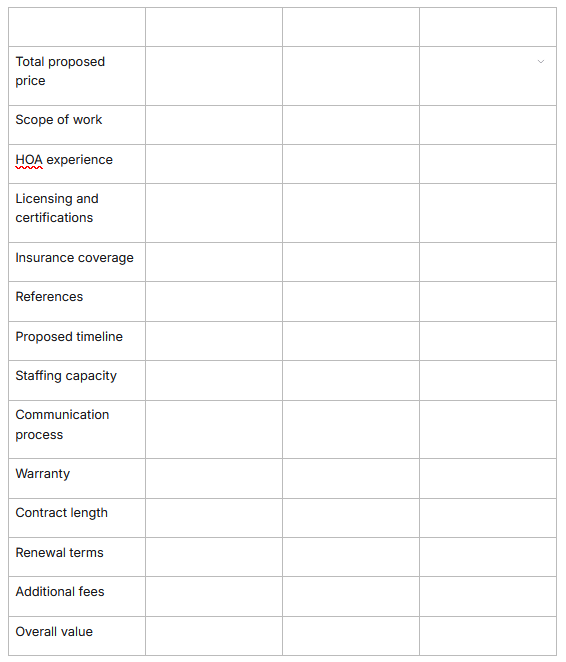
Seeing each proposal side by side often reveals strengths and weaknesses that are not obvious when reviewing proposals one at a time.
It also creates a documented evaluation process that shows the board considered multiple factors, not just price.
Use a Vendor Scorecard to Make the Decision More Objective

Once you’ve organized the proposals into a comparison matrix, the next step is evaluating each vendor using a consistent scoring system. A vendor scorecard helps boards move beyond opinions and focus on the factors that matter most.
Not every project carries the same priorities. For example, price may be the deciding factor for a routine service contract, such as grass cutting, while experience and technical expertise may be more important for a large roofing project or a structural repair at the pool. By assigning weight to each evaluation category, the board can compare proposals more evenly and reduce the influence of personal preferences.
Every community can adjust these percentages based on the project’s complexity and priorities. Your goal is to create a structured evaluation process that every board member understands before proposals are discussed.
Verify Every Vendor’s Qualifications
A professional proposal should always be supported by documentation that demonstrates the vendor is qualified to perform the work.
Before making a final decision, verify:
- Business licenses
- Professional or trade licenses, when applicable
- General liability insurance
- Workers’ compensation coverage
- Relevant certifications
- Experience with similar HOA communities
- Examples of comparable projects
- Safety procedures, when appropriate
- Subcontractor information
Don’t assume documentation is current just because it’s included with the proposal. Taking a few minutes to check licenses and insurance coverage can help reduce risk for your association.
Contact References Before Making a Decision
References provide valuable information that proposals cannot.
Speaking with previous clients allows the board to learn how the vendor performs after the contract is signed and whether expectations were consistently met.
When you can, ask for references from communities that are similar in size and needs to yours. Their experiences will usually be the most insightful.
Beware of Red Flags
Even well-written proposals can contain warning signs that deserve closer attention.
Be cautious if you encounter any of the following:
- A proposal priced dramatically lower than every other bid
- Vague descriptions of the work being performed
- Missing insurance or licensing documentation
- Refusal to provide references
- Heavy reliance on verbal promises rather than written commitments
- Large upfront payment requests
- Unclear change-order procedures
- No firm project timeline
- Automatic renewal clauses
- Restrictive cancellation terms
- Pressure to sign immediately
- A contract that differs significantly from the accepted proposal
One red flag doesn’t always mean you should rule out a vendor, but if you see several concerns, ask more questions before signing on a dotted line.
Review the Contract Carefully Before Signing
Selecting a vendor is only part of the process. The contract ultimately defines the vendor relationship with the association.
Before signing, confirm that the agreement clearly addresses certain things, including the scope of work, pricing and payment schedule, performance expectations, warranty terms, renewal provisions… just to name a few factors.
For large, long-term, or technically complex agreements, many associations choose to have their attorney review the contract before it’s executed.
Taking the time to review the final agreement can help avoid misunderstandings in the future.
Document the Board’s Decision
Transparency is an important part of the vendor selection process. Boards should maintain clear records showing how proposals were evaluated and why the final decision was made.
Keeping organized records shows the board used a thoughtful, consistent process and can help answer homeowner questions if they arise later.
Vendor Selection Doesn’t End After the Contract Is Signed
Awarding the contract is only the beginning of the relationship. Ongoing oversight helps ensure the vendor continues meeting expectations throughout the project or service agreement.
Boards or management should regularly monitor work quality, review invoices for accuracy, document service issues, and evaluate vendor performance prior to renewing the contract.
Remember, regular oversight helps protect your association’s investment and encourages accountability over the long haul.
How Professional HOA Management Simplifies Vendor Selection
Comparing vendor proposals takes time, organization, and attention to detail. For volunteer board members balancing these tasks with work, family, school, and other obligations can be challenging.
Professional HOA management services, like Kuester Management Group, can help streamline the process by developing detailed scopes of work, coordinating RFPs, gathering competitive bids, reviewing contracts, and much more. Kuester invites you to check out this additional resource for more information on how to select HOA vendors.
At the end of the day, experienced management helps boards document the evaluation process, communicate with vendors, and monitor performance after the contract starts, thereby providing valuable support from the beginning through to completion.
Choose the Best Value, Not Just the Lowest Price
Deciding on the right vendor helps protect your community’s long-term interests. A careful evaluation process lets boards look beyond price and take into account the vendor’s experience, communication style, qualifications, risk, and more. And all of this leads to informed decision-making, homeowner happiness, and attaining the community’s long-term goals.
If your association needs more guidance during the bidding and vendor selection process, Kuester Management Group would welcome the opportunity to assist. Reach out to our team today and schedule a 1:1 consultation.
FAQ
How many vendor bids should an HOA obtain?
Most communities get at least three competitive proposals when practical. However, the appropriate number may depend on the project itself
Is an HOA required to accept the lowest bid?
Not necessarily. Boards should generally focus on the best overall value for the community.
What should an HOA include in an RFP?
A Request for Proposal should clearly define the scope of work, project timeline, materials, service frequency, insurance requirements, licensing expectations, pricing format, warranties, submission instructions, and any other requirements.
How can an HOA compare bids with different scopes?
Start by providing every vendor with the same project scope whenever possible. If proposals differ, identify exclusions, clarify assumptions, and organize the information into a side-by-side comparison matrix.
What qualifications should an HOA vendor have?
Qualifications often include appropriate licenses, insurance coverage, relevant certifications, experience with similar communities, strong references, and sufficient staffing to complete the work.
Should an HOA use a vendor scorecard?
Yes. A weighted scorecard creates a more objective evaluation process and helps the board compare vendors consistently across multiple criteria.
What are the biggest red flags in an HOA vendor proposal?
Warning signs include unusually low pricing, vague scopes of work, missing documentation, excessive upfront payments, weak references, unclear timelines, restrictive contract terms, and pressure to sign immediately.
Can an HOA choose a previous vendor without requesting new bids?
This depends on the association’s governing documents, procurement policies, contract terms, and applicable laws. Even when rebidding is not required, periodically evaluating pricing and performance is considered a good practice.
Who should review HOA vendor contracts?
The board should carefully review contracts, and for larger or more complex projects, many associations also involve their property manager and legal counsel before signing.
How can an HOA management company help compare vendor bids?
A professional management company can help prepare the project scope, coordinate requests for proposals, organize vendor submissions, verify qualifications, review contracts, assist with negotiations, and monitor vendor performance throughout the project.