

No matter if you are getting ready for an annual meeting, a board meeting, or a special membership meeting, one key factor decides if official business can happen: quorum.
HOA board members often spend weeks arranging meetings, sending out notices, and making agendas, only to find they do not have enough people to do business. This can mean postponing elections, delaying votes, and moving important decisions to another day. Knowing about quorum ahead of time can help you avoid these problems and keep your association running smoothly.
This HOA quorum cheat sheet covers what quorum is, where to find your association’s requirements, how to figure it out, and what to do if your community does not meet it. Every HOA has its own rules and state laws, but the tips below give you a practical way to get ready for your next meeting.
At Kuester Management Group, a leading provider of HOA Management in Myrtle Beach SC, Charlotte NC, Huntersville NC, Wilmington NC, and Fort Mill SC, our team works hand-in-hand with homeowners associations to help their communities achieve quorum and run successful meetings.
What Is a Quorum?
A quorum is the minimum number of people who need to take part before an HOA can do official business.
Having quorum does not mean a proposal has passed or that everyone agrees. It just means enough eligible people are present for the meeting to go ahead, following your association’s rules and the law.
If there is no quorum, most official actions like elections and binding votes usually cannot happen.
Where Do HOA Quorum Requirements Come From?
A common misunderstanding is that all HOAs have the same quorum requirement. In fact, there is no single percentage that works for every community.
Instead, boards need to check several sources before each meeting.
These commonly include:
- The HOA’s bylaws
- The declaration or CC&Rs
- Articles of incorporation
- Applicable state law
- Election rules
- Adopted parliamentary procedures, when applicable
Since requirements can change depending on your state, meeting type, and rules, boards should regularly double-check quorum requirements before sending out meeting notices.
Important: Always confirm your association’s quorum requirements in both your governing documents and applicable state law before conducting official business.
HOA Quorum Cheat Sheet
The table below gives a general idea of how quorum usually works for different types of HOA meetings.
| Annual membership meeting | Eligible voting interests or members | Bylaws and applicable state law | Elections or official business may need to be postponed |
| Special membership meeting | Eligible voting interests | Governing documents and meeting notice | Official action generally cannot proceed |
| Regular board meeting | Required number of directors | Bylaws and applicable law | Board usually cannot vote or conduct official business |
| Committee meeting | Committee members | Committee charter or board policy | Committee may be unable to make formal recommendations |
| Reconvened meeting | As specified in governing documents | Bylaws and state law | Reduced quorum may apply if expressly authorized |
These are just general guidelines. Each association should check its own rules and state laws before deciding on quorum requirements.
Board Meeting Quorum vs. Membership Quorum

People are often confused about the difference between a board quorum and a membership quorum.
Both have participation requirements, but they are used for different reasons.
Board Meeting Quorum
Board quorum means the number of directors needed to hold an official board meeting.
For example, if your board has seven directors and your rules say you need a majority for quorum, at least four directors must be there before you can do official board business.
Homeowners who attend the meeting usually do not count toward the board’s quorum.
Membership Meeting Quorum
Membership quorum is used for annual meetings, elections, or special meetings that include homeowners.
Instead of counting directors, the association counts eligible voting interests represented at the meeting through approved participation methods.
Depending on the governing documents, participation may include:
- Homeowners coming in person
- Valid proxy holders
- Approved absentee ballots
- Electronic ballots
- Online attendance, when permitted
Meeting the board quorum does not automatically mean you have met the membership quorum, and the other way around.
How to Calculate HOA Quorum
Figuring out quorum is often easier than most people think.
The general formula is:
Total eligible voting interests × Required quorum percentage = Minimum participation required
The main thing is to find two pieces of information:
- The total number of eligible voting interests
- The quorum percentage established by your governing documents
Example One
Community size: 100 voting interests
Required quorum: 20%
Calculation:
100 × .20 = 20
You need at least 20 eligible voting interests present before you can do official business.
Example Two
Community size: 240 voting interests
Required quorum: 25%
Calculation:
240 × .25 = 60
The association would need 60 voting interests present to have quorum.
Example Three: Board Meetings
Board size: Seven directors
Required quorum: Majority
A majority of seven directors means four directors.
If only three directors show up, the board usually does not have quorum to do official business.
Sometimes the calculation does not produce a whole number.
For example:
125 voting interests × 20% = 25
There is no problem in this case.
However:
127 voting interests × 20% = 25.4
Whether you should round up depends on your rules and the law. Boards should check the right way to calculate before the meeting instead of guessing.
It is also important to remember that quorum is usually based on voting interests, not just the number of people.
For example, a married couple who own one property together may both attend the meeting, but they still count as only one voting interest.
What Counts Toward Quorum?
Many boards assume quorum only includes homeowners physically attending a meeting. That is not always the case.
Depending on your rules and the law, different ways of participating may count toward quorum.
These may include:
- 1:1 attendance
- Valid proxies
- Absentee ballots
- Mailed ballots
- Electronic ballots
- Online attendance
- Written consents, when authorized
The key thing is that these ways of participating only count if your rules and the law specifically allow them.
For example, some associations permit proxy voting but not electronic voting. Others allow virtual participation under certain conditions, while some still require homeowners to attend in person.
Before relying on any participation method, boards should verify that it is authorized for both the meeting type and the action being considered.
Proper planning before the meeting helps avoid confusion once voting begins and ensures the association follows the procedures established in its governing documents.
Quorum vs. Majority Vote: Understanding the Difference
People often use quorum and majority vote interchangeably, but they are two very different concepts.
Quorum determines whether the meeting can legally conduct business. A majority vote determines whether a motion passes once the meeting is properly underway.
You can think of quorum as opening the door to decision-making. Without it, the board or membership usually cannot move forward with official business. Once quorum is established, votes are decided according to the requirements in the governing documents.
For example:
- Quorum answers the question, “Can we conduct business?”
- A majority vote answers the question, “Did this motion pass?”
Some actions may require more than a simple majority. Depending on the governing documents, amendments to governing documents, special assessments, or other significant actions may require supermajority approval or other voting thresholds.
Understanding this difference helps boards avoid misunderstanding during meetings and ensures votes are handled correctly.
When Should Quorum Be Confirmed?
Quorum should not be an afterthought. It should be checked before the meeting starts and monitored during the meeting if needed.
Most boards confirm quorum:
- Before calling the meeting to order
- Before elections begin
- Before major votes are taken
- When attendance changes significantly during the meeting
The board secretary, community manager, or another designated individual often verifies attendance and confirms whether quorum has been achieved.
Recording quorum in the meeting minutes also creates a clear record that proper procedures were followed.
What Happens If Quorum Is Not Met?
Not reaching quorum does not mean the meeting was a waste of time, but it usually limits what the association can do.
Without quorum, the board or membership generally cannot:
- Conduct elections
- Approve budgets, unless otherwise authorized
- Vote on official motions
- Adopt policies
- Amend governing documents
- Conduct other binding business
Depending on the governing documents, the meeting may instead be:
- Adjourned to another date
- Recessed and reconvened later
- Used for informational updates only
- Rescheduled after additional notice is provided
Some governing documents allow lower quorum requirements for reconvened meetings, while others do not. Boards should always check these procedures before making decisions.
Can an HOA Lose Quorum During a Meeting?
Yes.
Many people think that once quorum is established, it stays in place until the meeting ends. That is not always true.
If enough members leave before official business is finished, the meeting may lose quorum. When this happens, the board may no longer have the authority to continue official business.
For this reason, it is important to:
- Monitor attendance throughout longer meetings
- Record when attendees exit
- Confirm quorum before major votes if attendance has changed significantly
Keeping meetings organized and efficient also helps prevent homeowners from leaving before important business is finished.
Helpful Advice for Achieving Quorum
Low attendance is a frequent issue for HOA communities. Fortunately, many associations can improve participation with better planning and communication.
There are a number of strategies that can make a real difference.
Communicate Early and Often
Homeowners are more likely to attend meetings when they know why the meeting is important.
Rather than sending only the legally required notice, consider communicating using multiple channels, including:
- Email reminders
- Community newsletters
- Resident portals
- Text notifications, when available
- Community bulletin boards
Sending reminders well in advance often improves participation.
Share the Agenda Ahead of Time
People are more likely to attend when they know what will be discussed.
Sharing a clear agenda helps homeowners understand the meeting’s purpose and shows that the board values their time.
Make Participation Convenient
When allowed by your governing documents and the law, offering online attendance or electronic voting can greatly increase participation.
Communities should also consider:
- Scheduling annual meetings at convenient times
- Keeping meetings focused and organized
- Ending meetings on time whenever possible
Respecting homeowners’ schedules encourages them to participate in future meetings.
Explain Why Their Vote Matters
Many homeowners think their individual vote does not make a difference.
Boards can help improve turnout by explaining how quorum affects the community and why homeowner participation is needed for elections, budgets, and important decisions.
Educating homeowners often leads to greater engagement.
HOA Quorum Pre-Meeting Checklist
Before every meeting, take a few moments for reviewing the following checklist.
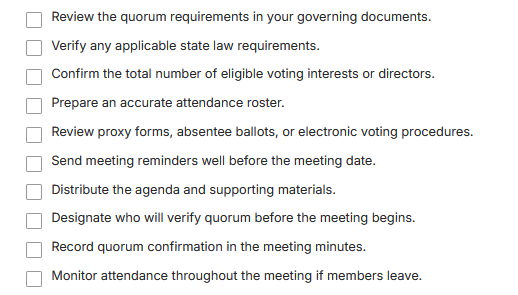
Taking a few minutes to prepare can prevent delays, confusion, and unnecessary rescheduling.
How Professional HOA Management Helps Boards Meet Quorum

Running successful meetings calls for more than just counting attendees. Boards need to make sure notices are sent properly, voting follows the rules, records are correct, and meetings meet all requirements.
An experienced HOA management company like Kuester Management Group can help boards prepare for meetings by coordinating notices, tracking attendance, organizing proxy submissions, preparing agendas, documenting meeting minutes, and helping associations follow established governance procedures.
What’s more is that professional management also helps boost homeowner engagement through clear communication, organized meeting preparation, and good documentation, making it easier for communities to reach quorum and conduct business efficiently.
Conduct Better Meetings Through Better Preparation
Quorum is beyond simply a formal procedure. It is a key part of effective HOA governance. When boards understand how quorum works and prepare for meetings ahead of time, they reduce delays, improve participation, and build trust with homeowners.
While each association’s governing documents may set different requirements, one thing is always true: preparation leads to better meetings.
If your board frequently struggles with meeting attendance, governance procedures, or homeowner participation, Kuester can help. Our experienced team supports HOA boards throughout the Carolinas with meeting coordination, communication support, financial management, governance guidance, and administrative expertise to help your community run more smoothly all year.
We invite you to reach out today to schedule a consultation. Kuester Management Group would love to be a resource to your HOA community.
Educational Disclaimer
This article is intended for educational purposes only and should not be considered legal advice. Quorum requirements vary based on an association’s governing documents, applicable state laws, and the type of meeting being conducted. Boards should consult their governing documents, community association manager, or legal counsel before making decisions regarding quorum, voting procedures, or meeting governance.
FAQ
What is quorum in an HOA?
Quorum is the minimum number of eligible voting interests or board members that must be represented before official business can be conducted.
Where can I find my HOA’s quorum requirements?
Quorum requirements are typically found in your association’s bylaws, declaration, articles of incorporation, and applicable state law.
Does every HOA have the same quorum requirement?
No. Quorum requirements vary from one association to another based on governing documents and state law.
Is board meeting quorum different from homeowner quorum?
Yes. Board quorum applies to meetings of the board of directors, while homeowner or membership quorum applies to annual meetings, elections, and other membership votes.
Do proxy votes count toward quorum?
They may. Whether proxies count depends on your governing documents and applicable state law.
Do electronic votes count toward quorum?
Some associations permit electronic voting or virtual participation, while others do not. Consistently verify your governing documents and applicable laws.
What happens if an HOA does not reach quorum?
Without quorum, the association generally cannot conduct official business, and the meeting may need to be adjourned or rescheduled.
Can quorum be lost after a meeting starts?
Yes. If enough members leave during the meeting, quorum may no longer exist, preventing additional official business from being conducted.
What is the difference between quorum and a majority vote?
Quorum determines whether business can be conducted. A majority vote determines whether a motion passes after quorum has been established.
Can an HOA reduce its quorum requirement?
Only if permitted by the governing documents and applicable law, often through a formal amendment process.
Why do HOA meetings often fail to reach quorum?
Common reasons include poor communication, inconvenient meeting times, homeowner apathy, lack of awareness about important agenda items, and limited participation options.
How can boards improve quorum?
Clear communication, advance reminders, convenient meeting times, online participation options where permitted, and educating homeowners about the importance of their participation can all improve attendance.
Who verifies quorum at an HOA meeting?
This responsibility is often handled by the board secretary, community manager, or another designated individual before the meeting is officially called to order.
How can an HOA management company help with quorum?
A professional management company can coordinate meeting notices, organize proxy submissions, prepare attendance records, document meeting minutes, support governance procedures, and help boards improve homeowner participation through better communication.